Rainy-Day Walking Shoe Guide: Water, Breathability, Wet Risk
Rainy-Day Walking Shoe Guide: Water, Breathability, Wet Risk
Rainy-Day Walking Shoe Guide: Water, Breathability, Wet Risk
When choosing shoes for rainy days, the real issue isn't whether they "look like waterproof shoes," but whether they can handle your actual route: light rain, puddled roads, long walks, or sidewalks that are still slippery after the rain.
This article is for people preparing to filter rainy-day walking shoes on the LitBuy product page but can't confirm protective performance from the main image alone. After reading, you should be able to complete a round of page evidence review, record confirmed information, unconfirmed risks, and whether further questions to the seller are needed.
This article is not a substitute for laboratory waterproof testing, and it cannot confirm that a particular shoe is non-slip, waterproof, or suitable for extreme weather. Product images and page descriptions can only provide clues, not automatically guarantee performance. 📌
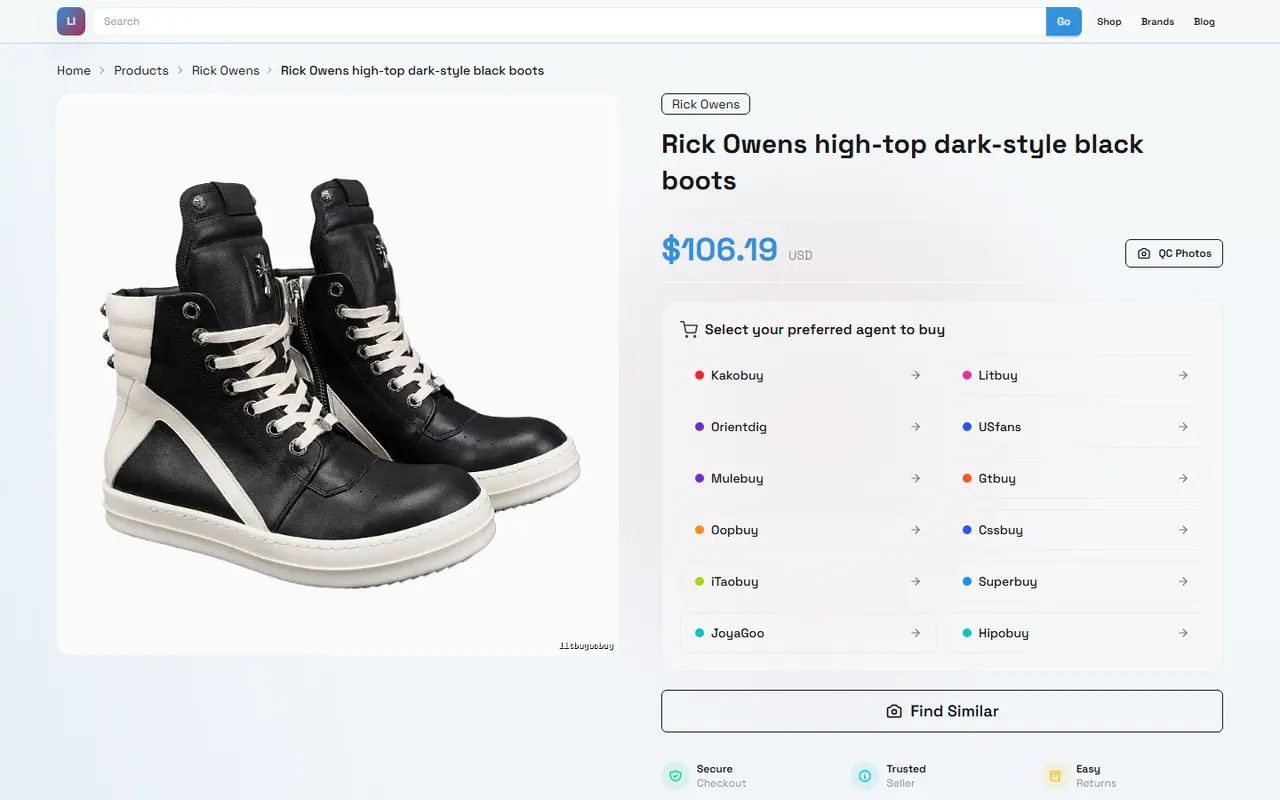
Image: Example screenshot of a product page, showing product information and QC Photos section. Page evidence verification date: October 6, 2026.
First Clarify the Protection and Comfort Tasks Needed for Rainy-Day Walking
Rainy-day shoes typically need to handle four things simultaneously: reduce rainwater entry, allow foot heat to escape, maintain sufficient stability on wet ground, and dry quickly after walking.
These goals are not always fully consistent. More complete upper coverage may help reduce direct rainwater entry; but if the upper, tongue, and collar form a relatively closed structure, internal moisture may also be harder to escape. Thick materials or high-top structures may increase coverage, but that doesn't necessarily mean seams, collar, or outsole perform better on wet ground.
Before starting to filter, write down your main scenarios clearly:
Short-distance commuting in light rain
Daily walking on wet roads after rain
Urban routes requiring continuous walking for several hours
Routes often passing through puddles, slopes, or smooth tiles
Situations where there's no place to dry shoes immediately after arriving at the destination
If the primary scenario isn't determined, descriptions on the page like "water-repellent," "wear-resistant," or "grip" are hard to translate into concrete choices. 🌧️
Distinguish Candidates for Light Rain, Wet Ground, and Continuous Rainfall on LitBuy
When filtering, don't start by concluding based on the term "waterproof shoes." Instead, compare candidate shoes in different risk scenarios.
For light rain, pay attention to whether the upper has obvious openings, mesh areas, or low seams. For wet ground after rain, focus on outsole tread pattern, sole coverage, and whether the lower part of the upper is likely to come into direct contact with puddles. For continuous rainfall, also consider collar height, tongue attachment, and whether internal moisture may accumulate over long periods.
You can create a brief record on the product page:
Does the page clearly state water-repellent or waterproof treatment?
Are different angles of the upper, collar, tongue, and sole shown?
Can you see the outsole tread clearly, or only side views?
Are QC Photos or other verifiable product inspection images provided?
Is information on materials, lining, sole, or structure given?
Which judgments are based only on image observation, and which have clear textual evidence?
If the page has only a front main image and you can't view the sole or seams, you should write "wet-ground risk unknown" in your record, not infer results from appearance.
Check Visible Protective Clues on Upper Coverage, Seams, Collar, and Tongue
Upper review can be done from top to bottom.
First, check if the upper coverage is continuous. Large exposed mesh areas, obvious ventilation holes, or low openings may let rainwater in more easily, but images alone cannot tell whether the material has been treated. Second, check if seams are concentrated in areas prone to bending or contact with rainwater. The more seam lines, the more details the page needs to provide; if image resolution is insufficient, don't treat visible stitching as proof of sealing.
Then look at the collar and tongue. A lower collar allows rainwater to enter from above; if the tongue has no obvious connection structure, there may also be a water entry path between the upper and tongue. High-top or closed structures can reduce some exposed areas, but still don't prove the entire shoe is waterproof.
Use this checklist during page review:
Are there large open mesh areas on the upper?
Is there continuous attachment on both sides of the tongue?
Does the collar have obvious elastic closure or padding?
Can you see the junction between upper and sole clearly?
Are seams and stitching located in flex zones?
Does the text description clearly distinguish water-repellent, waterproof, and ordinary durable?
"Water-repellent" can usually only serve as a clue for lighter rain situations; it should not be automatically understood as being able to wade in water for long periods or stay dry during continuous rainfall.
Compare the Potential Impact of Closed Structures on Breathability and Drying Needs
Breathability cannot be judged just by whether the upper has holes. Lining material, tongue structure, collar opening, sole thickness, and overall coverage all affect the release of heat and moisture.
A more closed upper may reduce direct entry of external water droplets, but it may also cause foot sweat to accumulate and escape more slowly. This is especially important for people who need to walk continuously. If the shoes are mainly for short distances, low temperatures, and light rain, protection may take priority; if the route is long, temperatures high, or feet sweat easily, drying time and ventilation conditions should be included in the judgment.
When the page does not provide breathability rates, drying times, or standardized test results, use conservative wording:
"Page shows ventilation areas," not "excellent breathability"
"Structure is relatively closed, internal moisture should be monitored," not "definitely stuffy"
"No drying test data," do not extrapolate drying duration on your own
Also consider post-use handling conditions before buying. Whether you can remove the insole, loosen the laces, and air-dry the shoes after arriving at the destination often matters more for the next wear than a vague breathability claim. 🍃
Build a Wet-Ground Observation Checklist from Outsole Tread Pattern and Coverage
Wet-ground risk needs to be judged separately. An upper that doesn't let water in doesn't mean stability on wet ground; outsole grip also cannot be concluded just because the tread looks deep.
When observing product images, first confirm whether there is a bottom-view photo of the outsole. If only side photos exist, you cannot judge tread direction, groove continuity, and coverage. Second, check whether the tread is distributed in the main load-bearing areas of the sole and whether there are large smooth areas. Finally, pay attention to the edge between the sole and the upper, as water and mud may affect stability there.
Record the following items:
Is there a clear bottom view of the sole?
Does the tread cover the forefoot, arch, and heel areas?
Are grooves likely to be filled with mud and sand?
Are there obvious smooth zones at the sole edge?
Does the page clearly state applicable surfaces or test conditions?
Is there verifiable textual evidence for wet ground, anti-slip, or wear resistance?
If the page does not provide standard tests, surface types, or experimental conditions, do not use definitive conclusions like "anti-slip" or "strong grip." A safer wording is "Outsole tread is visible, but wet-ground performance still needs actual testing or more specific test evidence."
Which Conclusions About Waterproofing, Grip, and Durability Cannot Be Guaranteed Solely by Product Images
Product images are suitable for confirming visible structure, not for replacing performance testing. The following conclusions in particular cannot be confirmed by images alone:
Stays dry after prolonged rain
Can step into puddles without water entering
Stable on smooth tiles, metal surfaces, or wet stone
Outsole maintains original grip after continuous use
Seams remain sealed after repeated bending
Materials are definitely wear-resistant, cold-resistant, or oil-resistant
Sizing, comfort, and support suit everyone
Even if the page provides QC Photos, they should be understood as auxiliary evidence of the product's condition or visible details, not a laboratory performance report. QC images can help you verify the upper, color, structure, and obvious flaws, but they cannot alone prove waterproof rating or wet-ground grip ability.
Before ordering, you can classify conclusions into three categories:
Confirmed: Facts directly supported by page text or clear images.
Clues: Images or descriptions provide direction, but testing conditions are lacking.
Unconfirmed: The page has insufficient information; you must verify further with the seller or platform.
This recording method reduces the risk of miswriting "looks suitable for rainy days" as "proven suitable for rainy days." 🔎
Set Selection Rules for Commuting Walks, Short Trips, and Post-Rain Surfaces
For light rain commuting, first confirm the exposure range of upper openings, tongue, and collar, then check for clear water-repellent statements. If the page lacks this information, treat it as a regular everyday shoe candidate, not a default rainy-day shoe.
For short trips, comfort, weight, and drying conditions may matter more than extreme protection. If the route is short, rain light, and you can change shoes and socks promptly, you can accept some unknown performance information, but still avoid pages where you can't view the sole, seams, and collar.
For post-rain surfaces, shift focus to outsole evidence. If there are only side views without bottom views, you cannot fully judge tread coverage; if the route includes slopes, tiles, or metal grates, list unknown grip risk as a primary limitation.
You can use a simple decision rule:
Clear upper, collar, and outsole information, and text descriptions clearly bounded: add to candidate list
Partial structural images, but missing outsole or seam evidence: only for low-risk, short-distance scenarios
Only promotional images, lacking material, structure, and testing conditions: do not classify as a rainy-day specific choice
Page information contradictory: suspend judgment, request clarification first
Final Action: Complete Page Evidence and Risk Review for Rainy-Day Shoes
When completing the review on the LitBuy page, follow this sequence:
First write down destination, rain conditions, walking duration, and surface type.
Check product name, description, and visible structural information, distinguishing facts from promotional language.
Verify whether usable images exist for upper, seams, collar, tongue, and sole.
Record the original meaning of statements about water-repellency, breathability, grip, and wear resistance, without overinterpreting.
Check whether QC Photos are available, and use them only for visible condition verification.
Classify conclusions into confirmed, clues, and unconfirmed.
Ask the seller or platform about critical unknowns before deciding to proceed.
Finally, don't just write "this shoe is suitable for rainy days." Instead, write an actionable judgment, for example: "The page shows relatively complete upper coverage, but no wet-ground testing and clear bottom view are provided, so it can only be considered a light rain short-distance candidate, and anti-slip or sustained waterproofing should not be treated as confirmed facts."
This method saves the cost of misjudgment, not promises a fixed amount. It suits people willing to verify evidence first and choose shoes based on route; it is not for those who need explicit waterproof ratings, professional anti-slip certification, or extreme weather gear. If the page cannot provide key structural and testing information, the safest action is not to keep guessing, but to abandon that candidate or switch to a page with more complete evidence.
Agent Platform Shopping FAQ
1. On litbuyacbuy.net, what steps should I take to figure out whether a product's quality is good enough?
When you're shopping on litbuyacbuy.net, always look at the QC photos to judge product quality. The pictures provided by the factory are often edited or enhanced, so don't base your decision on those alone. Instead, use the QC photos to verify that the item matches your exact detail requirements before committing to a purchase. Additionally, steer clear of listings with unusually low prices on litbuyacbuy.net, since these typically indicate poor quality.
Browse our latest products and find your next favorite item.