litbuyacbuy Cycling Jersey Spreadsheet Guide
litbuyacbuy Cycling Jersey Spreadsheet Guide
litbuyacbuy Cycling Jersey Spreadsheet Guide: Filter by Riding Position, Pocket Layout, and Seasonal Layering
A cycling jersey can't be judged solely by its color scheme and front display photos. What truly affects the user experience is the length under a riding position, whether the cuffs and hem stay stable, whether the rear pockets can hold your essentials, and whether the fabric and fit are suitable for the intended season.
This article helps you use the litbuyacbuy Spreadsheet to build a candidate list, then eliminate unsuitable jerseys one by one based on product pages, size data, and QC images. It applies to road cycling, commuting, and general recreational cycling purchases; if you need certified competition gear, crash protection, or professional waterproof clothing, you should directly check the manufacturer's technical documents and relevant certifications rather than rely solely on Spreadsheet entries.
Verification date: August 27, 2026. Product links, prices, inventory, sizes, seller information, shipping routes, fees, and return/exchange policies may change, so you should recheck the actual page and checkout information when placing an order.
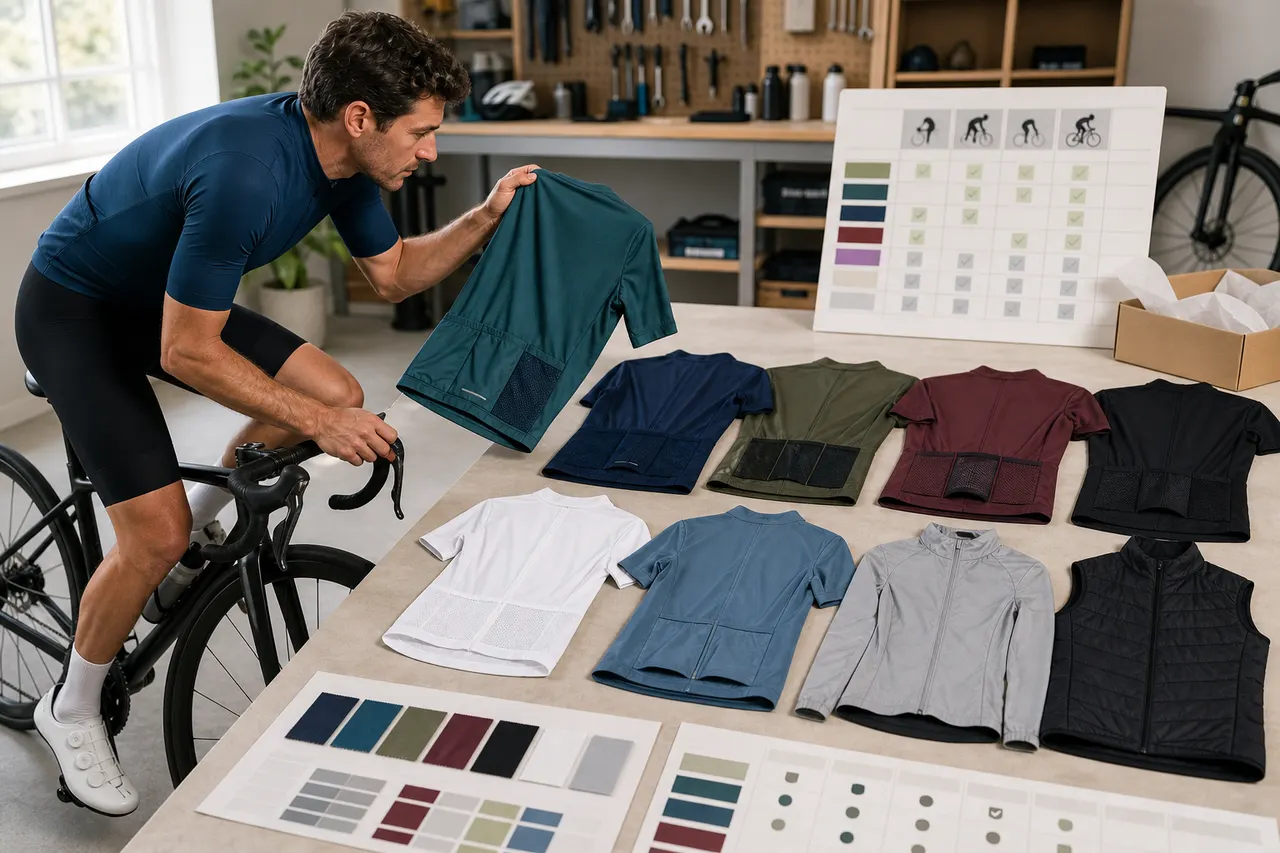
Figure: Filter candidate cycling jerseys from four directions: riding task, fit structure, storage needs, and seasonal layering.
First Determine Riding Distance, Weather, and Carrying Needs
Before browsing, write down your most common riding task. The more specific the task, the less likely you'll be swayed by colors, patterns, or low prices. 🚴
At least record the following information:
Duration and distance of a single ride, e.g., 40-minute commute or 3-hour weekend ride
Main posture: more upright city riding, or sustained forward-leaning road riding
Expected temperature, wind, and chance of rain
Whether you need to add a moisture-wicking base layer underneath, or a vest or windbreaker on top
Number and size of items to carry, e.g., phone, keys, nutrition, and basic tools
Whether you often ride at dawn, dusk, or night
Don't vaguely search for the "best-looking jersey." A more effective task description is: "Need a long-sleeve jersey suitable for 15°C to 22°C, sustained forward lean for about two hours, with separate pockets for phone and nutrition." The temperature range is just your usage condition, not a guarantee that any unverified product will surely work.
Use litbuyacbuy Spreadsheet to Build a Candidate List
Treat the litbuyacbuy Spreadsheet as an entry point for discovering and organizing candidate products, not the final basis for product facts. Names, images, or categories in the Spreadsheet can help with initial screening, but whether a product is still available, its current price, available sizes, and specific materials should be based on the valid product page after opening it and the information shown at checkout.
For initial screening, keep 5 to 8 candidates instead of ordering immediately upon seeing an entry. Record for each candidate:
Entry name or identifier in the Spreadsheet
Whether the product page opens properly
Whether the page has a clear product name and selectable specifications
Whether the size chart uses centimeters or inches
Whether front, back, side, and detail views are shown
Whether you can confirm the number of rear pockets, zipper type, and sleeve length
What information is still missing and needs to be confirmed through QC or pre-order inquiry
If a link redirects to an unrelated page, shows only blurry images, lacks a product name, or cannot confirm the specific style being sold, mark it as an invalid candidate rather than continuing to speculate based on old titles.
Judge Length, Sleeve Style, and Hem Structure by Riding Position
A jersey that looks fitted when standing may not fit well when leaning forward. When judging fit, check front length, back length, shoulder/sleeve structure, and hem grip separately.
Riding Task | Priority Checks | Common Reasons for Rejection |
|---|---|---|
Upright commuting | Standing coverage, range of motion, everyday wear convenience | Front hem too short, inconvenient to wear off the bike |
Road forward lean | Whether front hem bunches, whether back hem covers lower back | Back hem too short, rides up when bent over |
Long-distance riding | Shoulder mobility, cuff stability, hem grip | Restricted shoulders or hem constantly rolling up |
Recreational riding | Looseness, space for inner layers, pocket security | Fit too tight or pockets lack securing structure |
When viewing product images, note whether the back hem is significantly longer than the front, whether the inside of the hem shows grip structure, and whether the cuffs are plain folded, elastic panels, or fitted construction. Details not shown in images should be marked as "to be confirmed"; don't automatically assume unclear parts exist.
Also, don't rely solely on your usual S, M, or L size. Letter sizes can correspond to different measurements across products, so compare chest, length, shoulder width, and sleeve length first. If the page only gives recommended body ranges, confirm they aren't garment flat measurements.
Check Fabric Info, Ventilation Zones, and Seasonal Layering Space
"Breathable," "quick-dry," and "warm" are just marketing claims unless supported by materials, structure, or applicable conditions. 🌦️
For each candidate, check:
Whether fiber composition and proportions are listed
Whether the main body, sleeves, and side panels use different fabrics
Whether there are visible mesh areas on the back, underarms, or sides
Whether the fabric is obviously brushed, and whether the page shows the inside
Whether the cut is close-fitting and can accommodate the planned base layer
Whether there are windproof or water-repellent claims, and to which parts they apply
Seasonal layering needs room for movement and breathability. If you plan to add a moisture-wicking base layer, measure chest and waist with an existing suitable combination and compare to the product size chart. Don't blindly size up just to fit an inner layer, as an oversized jersey may flap at higher speeds and sag more when rear pockets are loaded.
In cold weather, simply adding thickness doesn't equal full protection. Wind resistance on the front, sweat wicking, and insulation when stopped may differ, so treat the jersey as part of a layering system.
Compare Practical Use of Rear Pockets, Zippers, and Reflective Details
More rear pockets don't necessarily mean more practical; what matters is compartment separation, opening position, and stability when loaded. 📱
If you need to carry phone, keys, and nutrition, prioritize confirming:
Whether hard items and food can at least be separated
Whether a middle pocket fits the phone without excessive sway
Whether there's a zippered small pocket for keys or cards
Whether pocket openings have elastic tightening
Whether the back view completely shows the pockets and their stitching
For zippers, check if they are full, half, or short zip, and whether there's a flap at the top to prevent neck chafing. Full zips usually offer better ventilation and easier on/off, but smoothness, durability, and locking ability cannot be judged from front photos alone; QC images may not verify long-term durability.
Reflective strips or logos are only supplementary details for visibility, not replacements for lights, legally required reflectors, and safe riding habits. If the product page doesn't mention reflective material, ordinary bright prints cannot be automatically considered reflective.
What to Confirm When Reviewing Size Charts and QC Images
Before looking at size charts, record your body measurements and flat measurements of a well-fitting jersey in the same unit. Keep measurement methods consistent, especially don't mix half-chest and full chest circumference.
Recommended checks:
Whether chest width is underarm flat width or full chest circumference
Whether front and back lengths are provided separately
Whether sleeve length is measured from shoulder point, neckline, or underarm
Whether the size chart notes possible measurement errors
Whether figures come from actual product measurements, factory tables, or general recommendations
QC images serve to verify the specific product received at the warehouse, not to prove material performance or long-term durability. 🔍 Focus on:
Whether size label, color, and style match the order
Whether front/back prints, panels, and pocket layout are correct
Whether the zipper is obviously crooked, or seams have visible breaks
Whether cuffs, collar, and hem show obvious asymmetry
Whether stains, damage, delamination, or large print defects are visible
If warehouse measurement service is offered, whether measurement positions match the size chart
Image angle, folding, and lighting can affect judgment. If in doubt about length, chest width, or pocket structure, request clear photos or measurements of the specific area rather than guessing from a single folded image. If a problem is found, check available options within the order processing window.
Before Ordering: Verify Links, Logistics, and Return/Exchange Boundaries
When ready to order, reopen each retained candidate's product page and record the verification date. At least confirm the link still works, specifications are correct, price and stock are shown, seller information is visible, and what cancellation, return, or after-sales options the current order process offers.
Final cost for cross-border orders isn't just the product price. It may also involve domestic shipping, warehouse handling, value-added services, international shipping, payment fees, destination taxes, and other applicable costs. Actual amounts depend on the order, package data, chosen route, and destination, and should be based on the checkout page and carrier terms.
Actual package weight and volume of a jersey may not be accurately determined before warehousing, so don't commit to shipping costs using unverified estimates. Consolidation may reduce repeated fixed fees but could also increase chargeable weight, package value, and per-shipment loss risk; splitting may increase fixed costs but might suit route restrictions or risk spreading. Calculate after warehouse data is available, not with a fixed formula.
For customs clearance, provide required product information truthfully and comply with destination import, declaration, and tax regulations. Don't request under-declaration, false descriptions, or methods to evade inspection. Products with brand logos may also involve intellectual property and carrier restrictions; if legality or shipping eligibility cannot be confirmed, don't proceed.
Return/exchange terms may depend on seller rules, order status, product condition, and processing deadlines. Confirm the current page's terms before ordering; if key information is missing, treat it as a risk rather than assuming a no-questions-asked return is possible.
Final Action: Keep Only Candidates That Best Fit the Riding Task
After checks, retain only candidates that answer:
Which riding posture and planned distance does it suit?
What visible data supports the fit and size?
Can rear pockets safely carry the planned items?
Do fabric and structure support the intended weather and layering?
What specific details still need confirmation at QC stage?
Have link, costs, logistics restrictions, and return terms been rechecked on order day?
If two candidates are close, prefer the one with more complete info, more verifiable sizing, and pocket layout that better matches the task, not simply the lower price. Information gaps are themselves costs and risks.
This filtering method may save rework costs from buying wrong sizes, useless pocket layouts, or season-inappropriate styles; without specific product prices, warehouse data, and shipping quotes, no definite savings can be promised. Added costs are mainly the time for upfront measurements and item-by-item checks, while risks of cross-border shipping, size discrepancies, and after-sales deadlines remain.
It suits buyers willing to compare multiple candidates by riding task and able to view size and QC materials. Not recommended for those in a rush, unable to confirm link validity, needing professional safety certification, or unable to accept uncertainty in cross-border returns. ✅
Editorial note: This article was generated by Panda-Buy Editorial Desk's automated content process, with fact, originality, and risk checks based on the provided platform scope and verifiable information boundaries; it does not represent actual purchase, wearing, or testing experience.
agent Platform Shopping FAQ
1. What can I do on litbuyacbuy.net if the item I received doesn't meet my expectations?
Reach out to litbuyacbuy.net's customer service team immediately. The majority of standard goods purchased from Chinese sellers on litbuyacbuy.net qualify for a 5-day unconditional return or exchange period. Should you be unhappy with the product, you may ask for a return. In cases where the package has already been shipped from the warehouse and delivered to your location, and you then notice a defect, you must contact litbuyacbuy.net's support staff so they can assist you in communicating with the seller to work out a suitable reimbursement arrangement.
Customer service email contacts for various platforms are listed below:
kakobuy: [email protected]
oopbuy: [email protected]
usfans: [email protected]
hipobuy: [email protected]
superbuy: [email protected]
Browse our latest products and find your next favorite item.